The great thing about studying ecology is that in every class and lecture everything we look at is relevant and important to our daily lives. I know the anthropologists, sociologists and maybe even the engineers will say the same thing, but I have the bias that ecologists and geographers are the ones that are looking at the really important stuff. The other day in my core Environmental Studies lecture our prof came equipped with a catalog of ritzy food from President’s Choice (a major Canadian packaged food brand). As she flipped through the heavily bookmarked and highlighted pages puzzling at the exotic and psudo-ethical products such as salt from the Himalayas and rare coffee beans she basically transformed into this guy:
She went on give a lecture on food and agriculture, a sector that has – perhaps justifiably – twice as much of a greenhouse gas contribution than personal transport. Even if we are willing to take a little heat so that we can eat, it’s worth looking at how the food business works and where we can make changes. We tried out a flashy new website that I want to share with you. Like the all ecological footprint calculators out there, this variant somehow takes all the varied variables and brings them into a very accessible package. It’s called the Low Carbon Diet Calculator and it is provided by sustainable food management company Bon Appetit, and should be taken with a grain of Himalayan salt.
‘Abdu’l-Baha, the Son of the Prophet-Founder of the Baha’i Faith and its Master indicated that meat is on its way into history, and “that our natural diet is that which grows out of the ground”, and in different tablets and talks He highlighted that we are meant to eat fruits, nuts, oils and grain. In another place He stated that if humankind “lived according to a natural, inborn equilibrium, without following wherever their passions led, it is undeniable that diseases would no longer take the ascendant, nor diversify with such intensity.”
Human health is another story, sufficed to say that what ‘Abdu’l-Baha said keeps getting truer and truer. If we expand to the disease of climate change caused by our unsettling of the planet’s equilibrium, let’s see if these principles hold any water. A meal of seasonal fruit, some nuts and oats at one once each earns us 170 carbon dioxide equivalent (CO2e) points and a cheery, temperate background.
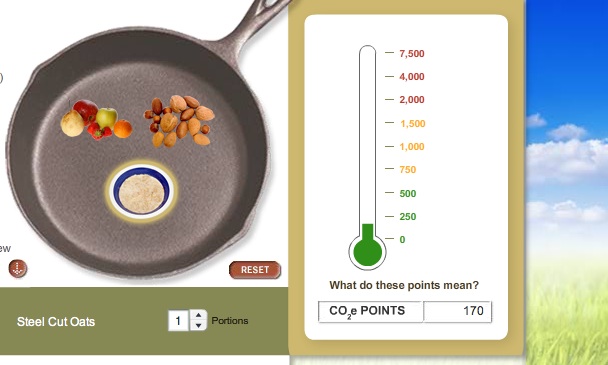
As ‘Abdu’l-Baha indicates, “meat is nourishing and containeth the elements of herbs, seeds and fruits”. We know that there are those who survive on nothing but meat so let’s have a three ounce meal of grilled steak, fried chicken and some fish from far away. The outcome is 1637 CO2e points, orange on the threat meter and a desert landscape. It doesn’t quite break the meter (which you can totally do) but point is to freak us out a bit.

Now I have no idea what eating an ounce of anything means because I’m a Canadaian, but apparently it means something here. Was my example arbitrary and biased? Of course it was. Try it yourself. For more on the Baha’i teachings on meat, check out my Meaty Compilation.


 Samuel Benoit

Leave a comment