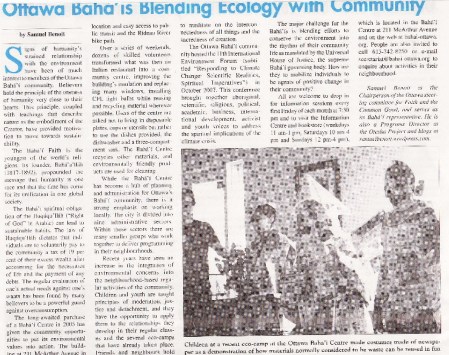
Literally dozens of Ottawa residents might find themselves reading my words as they grab a copy this month’s (November/December 2009) of the free newsletter Peace and Environment News (PEN) published by Peace and Environment Resource Centre. It was produced as part of an initiative with the Ottawa chapter of Faith and the Common Good, upon which I serve as Baha’i representative and chairperson. Faith and the Common Good is a really neat Canadian organization that works specifically with faith communities to help them address environmental and social justice problems.
The issue featured a number of articles from different Ottawa faith groups on their achievements and challenges in engaging in environmental action and the teachings that inspire them to do so. Click below to find a hyperlinked and illustrated original version to make those literally dozens who have read the articles become literally dozens plus another twelfth of a dozen.
Ottawa Bahá’ís work to blend ecology into the rhythm of their community life
Samuel Benoit
The Bahá’í Faith is the youngest of the world’s independent religions. Its founder, Bahá’u’lláh (1817-1892), is regarded by Bahá’ís as the most recent in the line of Messengers of God that stretches back beyond recorded time and that includes Abraham, Moses, Buddha, Krishna, Zoroaster, Christ and Muhammad. The central theme of Bahá’u’lláh’s message is that humanity is one single race and that the day has come for its unification in one global society.
Constantly emerging signs of humanity’s strained relationship with the environment have been of much interest to members of the Bahá’í community, and this concern has taken many forms here in Ottawa. Believers hold the principle of the oneness of humanity very close to their hearts, and this principle is coupled with teachings that describe nature as the embodiment of the Creator have provided ample motivation to move towards sustainability.
To name one feature of the Bahá’í practice that can lead to profoundly sustainable habits, there is the spiritual obligation of the Huqúqu’lláh (‘Right of God’ in Arabic). The law of Huqúqu’lláh dictates that individuals are to voluntarily pay a tax of 19% of one’s excess wealth after accounting for the necessities of life and upon the payment of any debts. The regular practice of evaluating one’s actual needs against one’s wants has been found by many believers to be a powerful guard against overconsumption.
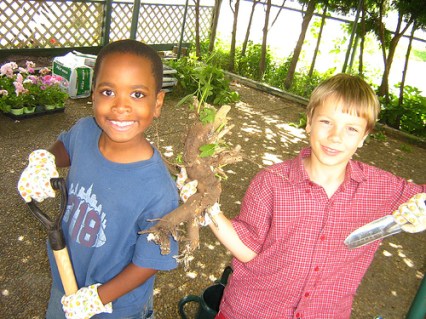
The long-awaited purchasing of a Bahá’í Centre in 2005 has continually given the community opportunities to put its environmental values into action, and this is a process that will surely continue over the years to come. The building at 211 McArthur Avenue in Vanier was largely chosen for its central location and easy access to public transit and the Rideau River bike path. Over a series of weekends, dozens of skilled volunteers transformed what was then an Italian restaurant into a community centre, improving the building’s insulation and replacing many windows, installing CFL light bulbs while reusing and recycling material wherever possible. Dishes are available and users of the centre are asked not to bring in any disposable plates, cups or utensils but rather to use the provided dishes, dishwasher and a three-compartment sink. The Bahá’í Centre is also equipped to recycle those other materials that do find their way into the building, and environmentally friendly products are used for cleaning.
While the Bahá’í Centre has become a hub of planning and administration for Ottawa’s community, there is a very strong emphasis in working locally as part of believers’ vision to work towards global unity. The city is divided into nine administrative ‘sectors’ and within those areas there are many smaller groups who work together to deliver programming in their neighbourhoods. There is a profound understanding of the role community is to play as we look towards the sort of adaptations required to live in harmony with the environment.
Recent years have seen an increase in the integration of such concerns into the neighbourhood-based regular activities of the community. Children and youth who are taught principles of moderation, justice and detachment are given the opportunity to apply those qualities to the causal relationships that are implicated in the environmental process in their regular children’s classes and the several ‘eco-camps’ that have already taken place. Informal devotional gatherings of friends and neighbours are meditating on the interconnectedness of all things and sacredness of creation.
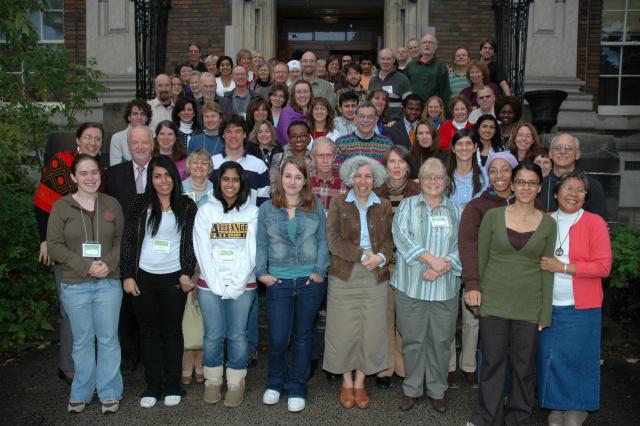
Along with regular activities, the Bahá’í community of Ottawa also aims to engage in environmental discourse through supporting the special events such as the 11th International Environment Forum conference (subtitled ‘Responding to Climate Change: Scientific Realities, Spiritual Imperatives’) which the community hosted in October 2007. This conference brought together aboriginal, scientific, religious, political, academic, business, international development, activist and youth voices to address the spiritual implications of the climate crisis.
The major challenge the Bahá’ís continue to face is the task of blending endeavours to conserve the environment into the rhythm of their community life as mandated by the Universal House of Justice, the supreme governing body of the entire Bahá’í world. How are they to carry on with their important work to mobilize individuals to be agents of positive change in their community undistracted? Much is being learned right now about how to integrate these concerns through an ongoing cycle of action, reflection and consultation.
The Bahá’í community of Ottawa continues to rise to the challenge of addressing the environmental crisis as a result of the mandate given to it by its own sacred teachings institutions, the motivation of its believers and thier desire to leverage the power of the teachings of Bahá’u’lláh to address the needs of the age.
All are welcome to drop in for information sessions every first Friday of each month at 7:30pm and to visit the Information Centre and bookstore (weekdays 11am-1pm, Saturdays 10am-4pm and Sundays 12pm-4pm), which is located within the Bahá’í Centre at 211 McArthur Avenue and on the web at bahai-ottawa.org. People are also invited to call 613 742 8250 or e-mail secretariat@bahai-ottawa.org to enquire about activities taking place in their neighbourhood.
Samuel Benoit is the Chairperson of the Ottawa steering committee for Faith and the Common Good, and serves as its Bahá’í representative. He is also a Programs Director at the Otesha Project and blogs at samuelbenoit.wordpress.com.

 Samuel Benoit
Leave a comment